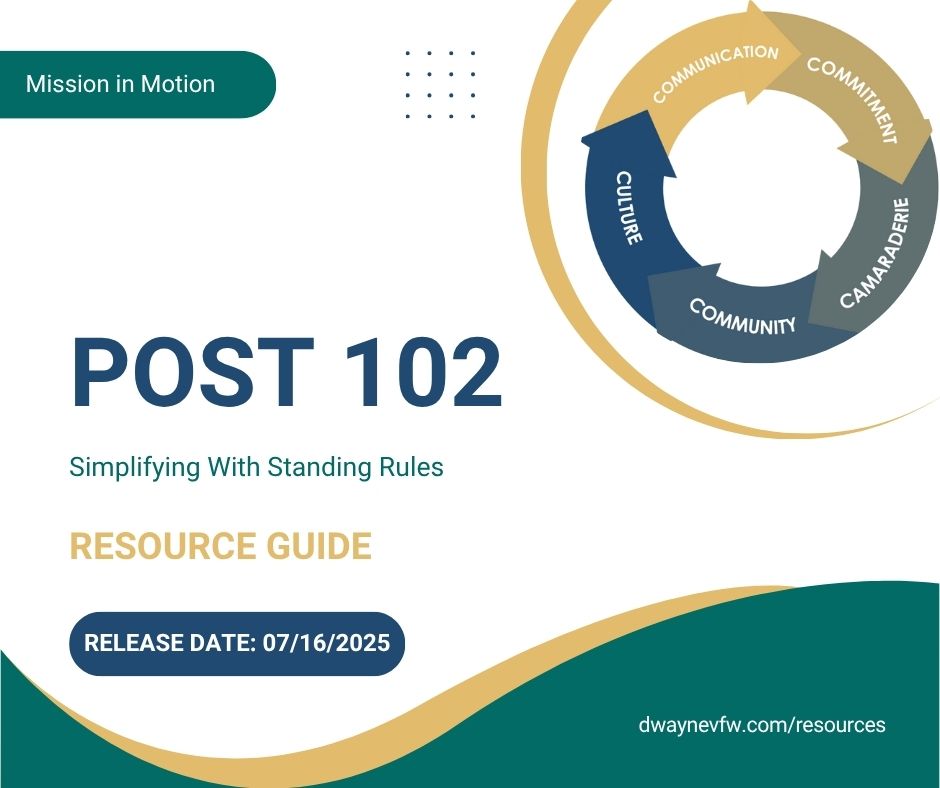
Clear, concise, and respectful communication is the foundation of a thriving, successful Veterans of Foreign Wars (VFW) Post. From the moment a prospective new member walks through the door to the coordination and execution of large-scale service projects, every successful Post relies on effective dialogue. Communication is not just what we say. Instead, it is how we listen, how we lead, and how we live the VFW mission. In this article, we’ll walk through the essential elements of strong communication at the Post level and provide practical insights, tips, and examples to help VFW members elevate their impact. From the wealth of historical data and observations, the strategies and tactics discussed form much of the communication foundation from which a successful VFW Post is built.

Understanding the VFW Communication Structure
How does communication work within the VFW, and how does it affect comrades and Posts within the organization? Simply put, communication within the VFW follows a structured flow that is designed to ensure accountability, unity, and clarity across all levels of the organization.
- Post-Level Communication: The Post is the grassroots; this is where it begins. Members discuss ideas, vote on motions, and plan events. Remember that our organization is member-driven; our bylaws set forth expectations, rights, and privileges – no single comrade has more votes than anyone else; as such, each comrade is on an equal playing field. Officers are held to a high standard and should be engaging the membership – young and old, new member and long-time member. Meeting minutes, officer reports, newsletters, and bulletin boards are typical communication tools. Beyond that, your Post may have a website, presence on social media, and much more.
- District and Department Communication: Post-level concerns, updates, and program results move up to the District and Department. Officers serve as liaisons, conveying accurate and timely information. The District-level is a bridge between the Department and the Post, often providing additional support, resources, and knowledge. The Department is the ultimate bridge between the Post and the National organization. Typically, the District and Department-level will have more established subsets of knowledge, resources, and communication infrastructure.
- National-Level Communication: Official correspondence and other forms of communication are regularly distributed from the National Headquarters in Kansas City, Missouri, and from the Washington [D.C.] Office. Examples of common communications include legislative advocacy from the D.C. office and membership campaigns, resource information, and national programs from the VFW National Headquarters. All information is communicated through official channels to include email newsletters, VFW Magazine, National Bulletins and General Orders, the VFW Website, social media profiles and pages, and the VFW National Convention.
Understanding the flow helps members, new and seasoned, know where to take an idea, where to raise a concern, and how to share success stories. While the VFW is a fraternal organization and not a military unit, the lessons learned from the concept of the Chain of Command can be extremely helpful to Posts and its members. Using that communication chain, a Post and its members can more efficiently solve challenges, share ideas and information, and distribute resources. Using the lowest level of the organization to solve problems, for example, best ensures that the organization is providing transparency, fostering an environment of teamwork and ownership, and ensuring that unnecessary bottlenecks within the organizational structure are avoided.

Mastering Meeting Communication
Post meetings are the heartbeat of VFW activity. The VFW Post is a business, and its members in good standing are its board members. The membership is charged with conducting the business of the organization, ensuring that local activities adhere to the overarching mission set forth in our Congressional Charter. Sure, meeting might feel like a pain at times, but they are necessary to do the business of the VFW. How the meetings are run and how participating members conduct themselves can be the difference between a successful, highly-functioning Post and one that is increasingly inefficient and unwelcoming. Here’s how to contribute within the meeting setting more effectively:
- Be Prepared: Read the agenda in advance. Know the key items up for discussion or vote. Have a topic or idea? If possible, don’t wait until the monthly meeting to begin the discussion. Instead, communicate with those comrades you more frequently engage with and possibly use as a sounding board. Hash out the idea and begin to build that groundswell of support PRIOR to the meeting day. Arrive at the meeting prepared to discuss your idea or concern in a professional and mission-focused way.
- Speak with Purpose: Purpose is important. Keep your comments mission-driven and be sure to stick to the facts. The VFW Post is NOT a place for petty jealousies or trivial personalities. Respect is expected on all sides of the discussion. Also, instead of repeating the same point over and over, add value to the discussion.
- Respect Protocol: Follow the Bylaws and Robert’s Rules of Order. Wait to be recognized, stay on topic, and use motions properly. If needed, practice these elements in advance and ask questions ahead of time.
Also, remember that how you say something is just as important as what you say. Some would contend that it is even more important. Example: Instead of saying something like, “We never get enough volunteers,” consider a more positive approach like, “I would propose that we create a volunteer rotation schedule for events, so responsibilities are shared more evenly.” You could have the best idea of the year, but how you express your idea or concern can turn the meeting audience for or against you.

Listening as a VFW Leadership Skill
Listening is one of the most powerful tools in any leader’s toolkit. It’s not just about hearing, for it is about understanding and acknowledging. We might be tempted to speak and not listen, but that approach will leave your Post less successful.
“We have two ears and one mouth so that we can listen twice as much as we speak.”
— Epictetus
Are we really absorbing what is being stated? Are we consuming the information provided to us from peers and from those at higher levels of the organization? Are we listening to the veterans and family members within the community? One of the basic techniques Post leadership can use is active listening.
Active Listening Techniques:
- Make eye contact
- Avoid interrupting
- Reflect back key points (“So what I hear you saying is…”)
These small habits build trust and make others feel heard, even during disagreement. In a diverse Post, where members range in age, branch, and experience, listening helps bridge gaps and strengthens unity. Through repetitive use of good habits, a Post can enhance commitment amongst its members and establish and grow enduring camaraderie within its ranks.

Navigating Conflict Constructively
Disagreements are inevitable. The VFW is not an organization filled with “Yes” people who just rubber stamp ideas from one leader. No, opinions differ, and disagreements occur. But, when handled well, they can lead to growth and innovation. But, how can we best navigate disagreements? Take these three (3) initial concepts under consideration.
- Separate the issue from the person. Focus on what’s being said, not who is saying it. Remember the whole trivial personalities aspect. Again, we are here to complete a mission – to serve veterans and family members. Focusing on the mission and the issue at hand allows problems to be solved. When we were in uniform on the battlefield, we had to trust those standing on each side of us. When we disagreed, we had to talk out the concerns – allowing personalities to creep in lends itself to some MAJOR issues down the road.
- Use “I” statements. Too often, we seek to point out the flaw in someone else’s argument or viewpoint. How we point out concerns makes a difference. “I’m concerned that we’re not reaching younger veterans and families” is more productive than “You never listen to new ideas.” Don’t put them on the defensive; instead, focus on your specific perception and feeling.
- Look for shared values. If you disagree about how to execute an event, remember: you both want to serve veterans. If we are here for the VFW mission, we definitely have common ground. Use that common ground in a positive way to navigate disagreements.
Stay calm, stay factual, and stay focused on the mission. End up on the wrong side of a decision? That will happen to each of us over the course of time. It is important to keep the overarching VFW Mission in mind and not allow the disappointment of something not going our way to negatively affect us and our steps forward.

Speaking on Behalf of the Post
Not all communication stays within the four walls of the Post. You may be called to speak with the media, represent the Post at a public event, or contribute to a community newsletter. If your Post is regularly engaging the world outside of the Post Home or meeting location, know that many opportunities to partner up and collaborate will become available, but how does communication work when outside of the Post Home?
Here’s how to get it right:
- Know your message. What is your VFW Post doing? What’s the overall outcome you want to focus on?
- Be concise and veteran-focused. “We’re collecting winter coats to support military families in our community” speaks directly to the mission.
- Maintain professionalism. Use respectful language and avoid internal Post politics or gossip.
A clear, well-delivered message strengthens your Post’s reputation and attracts new members, supporters, and partners. Also, it is important to understand who should be representing the Post in front of the cameras. Lastly, do you have District, State, and/or National Officers actively participating in the event? Make sure you know each person’s role, who should be doing the talking, and what the focus of the message should be. You are wearing the VFW cover – when you wear it, people listen to what you are saying.

Digital Communication Best Practices
Your Post’s website, Facebook page, Instagram, LinkedIn Page, and email newsletters are extensions of your brand. These tools can be leveraged to level up your internal and external communication. Do it well, and your Post is off to increased support and buy-in, overall growth, and critical success. Do it wrong, and things can quickly spiral out of control. Poor communication online can damage trust. Here’s how to keep it sharp:
- Designate administrators. Make sure only trusted officers or members can post official updates. Your Post Adjutant is your official communications officer, but you may also have others who can work with the Post Adjutant to lend their digital expertise. Collectively, the communication team should have a unified message, and those messages should also align with Department and National. For continuity with online presence (i.e. Facebook Pages), it is important that more than one person has administrator access. In recent years, Posts would also provide the State Adjutant or Quartermaster with administrator access. Know that these Department officers are not sifting through your materials or will look to post on your behalf; instead, they are there to safeguard the online pages along with you. Imagine if your Post Officers with administrator access to your digital pages suddenly pass away or decide to step away? Does your Post has a way to ensure it has access to all assets, including digital?
- Stay positive and mission-aligned. Focus on accomplishments, upcoming events, and veteran service. Official communication should not be laced with drama. For the larger Posts with a number of revenue streams (i.e. bingo, canteen, and COAM), be sure to find the right balance within your communication mix. The VFW is first a fraternal organization, not a bar or bingo hall. While those revenue streams are critical to operational survival, lest not forget why we have those revenue streams in the first place – to COMPLETE our mission. Section 230102 of our Congressional Charter reminds us of our overarching purposes. We need to be sure that we are communicating about that great work. If your internal or external communication reflects BAR BAR BAR or BAR BINGO BAR, your Post is either not optimizing its communication messaging or your Post may not fully be entrenched in the Mission. Often, we just forget to tell our stories well. We forget to communicate about the great work we are doing for veterans in the community, service projects we are planning, and positive impact we are having in the community.
- Use graphics and photos. A picture from a Post cleanup or student awards ceremony speaks volumes. Words are great, but our target audiences, both internally and externally, often consume ideas and information better when they have visual elements to reflect on. Your Post does the work – take a few photos or a short video and share it within your communication channels. Tell your members about the recent achievement, and make sure to inform your community supporters. When they see the great work you are doing, they will be more encouraged to jump in and participate in upcoming events and service projects.
Along the lines of communication, it is important to remember to be consistent. Try scheduling posts weekly or bi-weekly, so members and the community know when to expect updates. Whatever the schedule you set, strive to keep to that. Your fellow comrades and supporters will expect consistency within communication.

Real-World Example: Turning Things Around
At one Georgia VFW Post, declining meeting attendance, reduced event participation, and low morale were traced back to poor communication. Members felt uninformed and undervalued. When the new Post Commander realized the issue, the leadership team implemented some simple changes:
- Established a Quarterly Buddy Check Call process
- Created a monthly email newsletter
- Held brief “State of the Post” updates at meetings
- Encouraged every officer to call or text a few members personally
Within two quarters, meeting attendance doubled, and member engagement rebounded. Communication doesn’t require fancy tools—it just requires consistency and sincerity.

Final Thoughts: Communicate with Purpose, Listen with Heart
Strong communication is a muscle; like any muscle, it strengthens with practice. Whether you’re a newly joined member or a longtime officer in the VFW, your ability to communicate with purpose, patience, and respect will shape your Post’s success.
When we speak clearly, listen openly, and work together, we honor the very values that brought us to the VFW in the first place.
So, the next time you enter a Post meeting, greet a new member, or write an official email, remember: you are not just passing along random information. Instead, you are building a LEGACY one conversation at a time.